We use ultra flat ceiling paint to reduce the glare that makes ceiling imperfections easier to see under pot lights and daylight. Benjamin Moore Waterborne Ceiling Paint Ultra Flat (F508) gives us a low-sheen finish for these demanding surfaces.
Why do ceilings with pot lights show every flaw?
Ceiling flaws become more visible when light travels across the surface at a shallow angle. Small ridges and depressions cast shadows, while uneven paint sheen creates brighter patches. Pot lights can contribute, depending on their position and beam direction; large windows can create the same problem as daylight moves through the room.
Three different issues can look similar from the floor:
- Surface shape: a raised joint or patch edge creates a shadow.
- Uneven reflection: overlapping paint or a mismatched touch-up can look patchy.
- Discolouration: a stain needs attention beyond choosing a flatter finish.
For the related problem on vertical surfaces, see our guide to painting walls under critical light.
What should you do if your ceiling has pot lights?
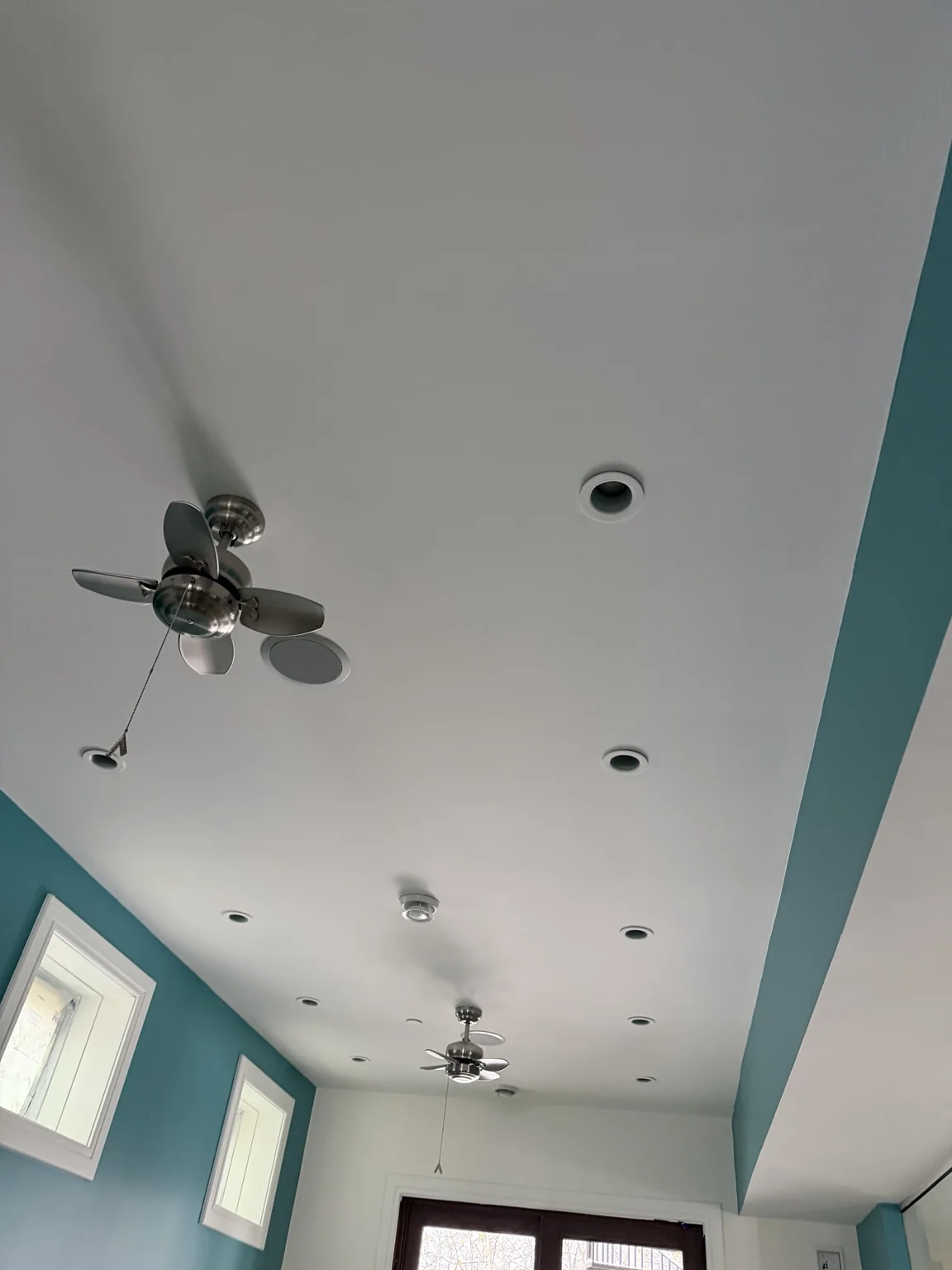
Start with the lights you actually use. Look across the ceiling with the pot lights on, then check it in daylight. Identify whether the visible problem is a repair edge, a stain or uneven reflection. Agree on the repairs and priming before choosing an ultra-flat finish for glare control.
For a repaint like the one pictured, the work has a clear sequence: protect the room, complete the ceiling touch-ups, prime the prepared surface and apply the finish coats. On this job, that meant full priming followed by two full coats of F508.
Keep the viewing conditions consistent when assessing the result. Stand where you normally enter or sit in the room, use your usual light settings and check the areas that first drew your attention. A close-up under a portable work light answers a different question from the view you live with.
What makes ultra flat ceiling paint different from wall paint?
Ultra flat ceiling paint is chosen to limit noticeable sheen across a broad overhead surface. Wall paints serve a wider range of needs, including frequent cleaning and contact. Compare the specific coating and its intended job: a wall paint labelled matte is not automatically equivalent to an ultra-flat ceiling finish.
Benjamin Moore’s Canadian F508 technical data sheet lists its sheen/gloss as 0–2 at 85°. That measures the coating’s sheen; it does not describe the smoothness of the drywall underneath.
“Flat” can also describe an untextured ceiling. Ultra-flat paint is a coating choice; texture removal is a separate project covered in our flat-ceiling and popcorn-conversion guide.
For broader finish comparisons, see our matte, satin and gloss guide. The practical question here is how the selected ceiling coating will look across a large surface under the room’s actual lighting.
Why do we use Benjamin Moore Waterborne Ceiling Paint?
We use Benjamin Moore Waterborne Ceiling Paint where reducing glare and keeping an even-looking finish are priorities. Benjamin Moore describes F508 as its most premium ceiling paint, with an ultra-flat finish that reduces glare and minimizes lap marks. Its low sheen is the reason we select it for this work.
The Benjamin Moore Canada product page also describes the product as formulated to minimize spatter. That is useful during rolling, although floors, furnishings and nearby finishes still need protection.
On this project, the ceilings were already in place in a home built about 15 years ago. The existing drywall work was well done. We were repainting those ceilings, with touch-ups completed before the coating work.
We masked all the floors and covered everything that needed protection. After completing the ceiling touch-ups, we fully primed the ceilings with INSL-X Aqua Lock Plus Primer/Sealer from Benjamin Moore. We then applied two full coats of Waterborne Ceiling Paint Ultra Flat (F508).
Application still matters. F508’s Canadian data sheet calls for maintaining a wet edge to avoid lap marks. A product formulated for minimal lapping still needs controlled application across the ceiling.
Watch our 42-second project film to see floor and finish protection, ceiling painting, sprayed trim and unmasking.
For the reasoning behind that sequence, read why painters paint ceilings first.
Where does drywall prep still matter?
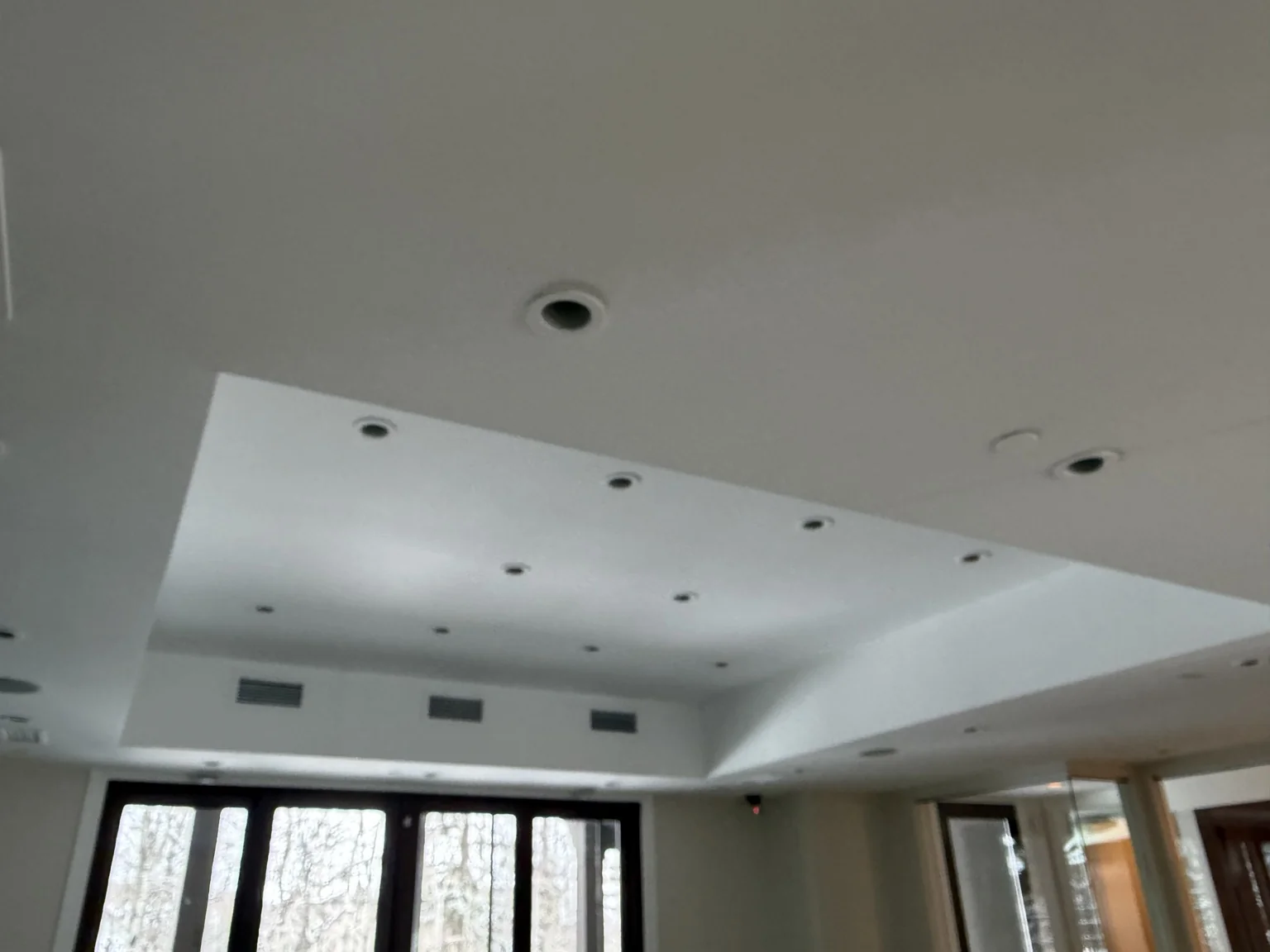
Level 4 is common, while Level 5 is the gold standard for demanding ceilings under strong light, consistent with the Gypsum Association’s GA-214 guidance on finish levels and critical lighting. Our drywall finish-level guide explains when each is appropriate and what to discuss before work begins.
We cannot confirm the original finish level of the ceilings in these photographs. They predated our work, and the original drywall finisher was unknown. What we could assess was their existing condition and the touch-ups needed before coating.
Ultra-flat paint controls reflection; it cannot flatten a raised joint or repair edge. Cracks, failed tape and patch edges belong in the ceiling repair scope.
Stains and primer selection require their own assessment, covered in our ceiling preparation and stain-blocking guide.
How does F508 compare with a standard flat ceiling paint?
Compare the exact products, not just the word “flat” on the label. F508 has a documented sheen of 0–2 at 85° and is formulated for ceiling glare and lap marks. Those specifications give you something concrete to compare with another coating’s technical sheet and intended use.
For this project, we chose F508 for the ceiling finish. These project photographs do not establish a performance difference between paints. When comparing estimates, ask for the named paint and the same preparation and coat count; a material substitution alone does not describe the whole job.
Can you tint ceiling paint?
Yes. Benjamin Moore’s Canadian guidance says Waterborne Ceiling Paint is available in any Benjamin Moore colour. A white ceiling is therefore a design choice, not a product restriction. Review the selected colour in the room’s daylight and artificial light before committing, because both influence how the ceiling looks beside the walls.
When isn’t ultra-flat ceiling paint the right choice?
Ultra-flat ceiling paint may be the wrong priority when a ceiling needs frequent scrubbing, faces repeated contact or has demanding exposure conditions. Choose for the room’s maintenance and environment as well as glare. F508’s Canadian data sheet says it is not intended for areas subject to abrasion, which matters when planning cleaning.
A bathroom, kitchen or indoor pool room needs a coating assessment based on its actual conditions. A failed surface or recurring stain needs its cause addressed before selecting a finish.
Frequently asked questions
Should I check the ceiling with the pot lights on?
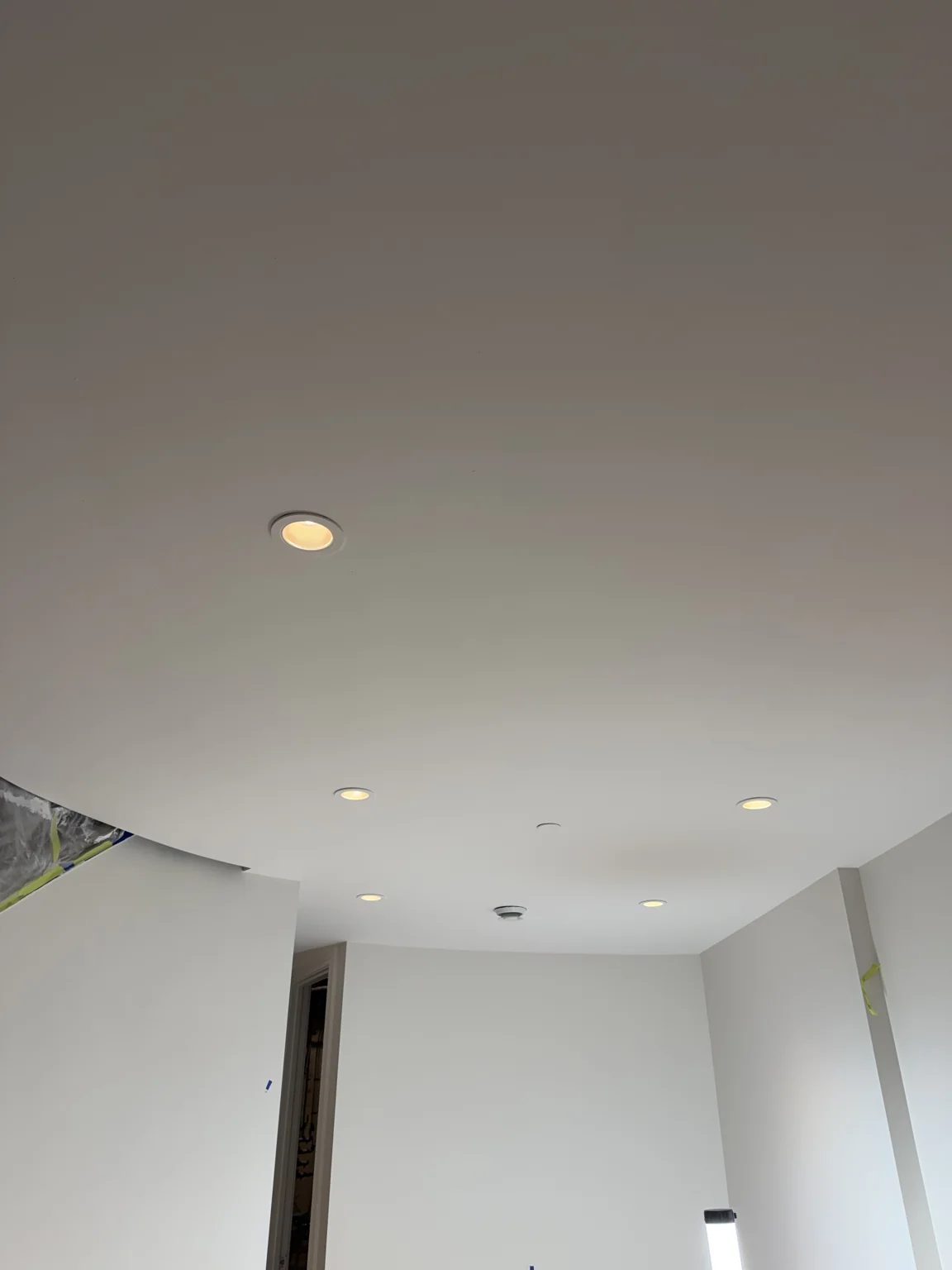
Yes. Use your normal light settings and look from the room’s usual viewing positions. Check in daylight too, because windows and recessed fixtures can reveal different areas.
Why does my ceiling look patchy only when the lights are on?
Artificial light can reveal differences in surface shape or paint reflection that softer lighting conceals. Inspecting the ceiling under daylight and its installed lights can help distinguish drywall irregularities from coating problems.
Is Benjamin Moore Waterborne Ceiling Paint worth it for ceilings with pot lights?
It is a product we choose when glare and an even-looking finish are priorities. The useful question is whether reducing visible reflection matters in your room. Discuss the coating choice alongside the preparation and application included in the estimate.
Do all ceilings with pot lights need Level 5 finishing?
No. Pot lights alone do not establish the required drywall finish. Light direction, existing surface condition and the expected appearance determine whether more extensive finishing should be included in the project.
Which primer did you use on these ceilings?
We used INSL-X Aqua Lock Plus Primer/Sealer from Benjamin Moore. After completing the ceiling touch-ups, we fully primed the existing ceilings before applying two full coats of F508.
Request a free ceiling painting estimate
Dynamic Painting Inc. provides residential ceiling painting in Calgary, Airdrie, Cochrane and Chestermere, Alberta. For budget planning, our ceiling painting cost guide explains the scope factors to consider.
When you reach out, tell us when the problem is most visible and which lights you normally use. That helps connect the proposed work to the conditions you actually live with.
Request a free painting estimate so we can assess your ceiling, lighting and preparation needs together.
About the author
Marc Sharkey is the founder and owner of Dynamic Painting Inc., a residential painting company serving Calgary and surrounding Alberta communities. He leads project assessments and planning, including surface preparation, coating choices and the written scope of work.