
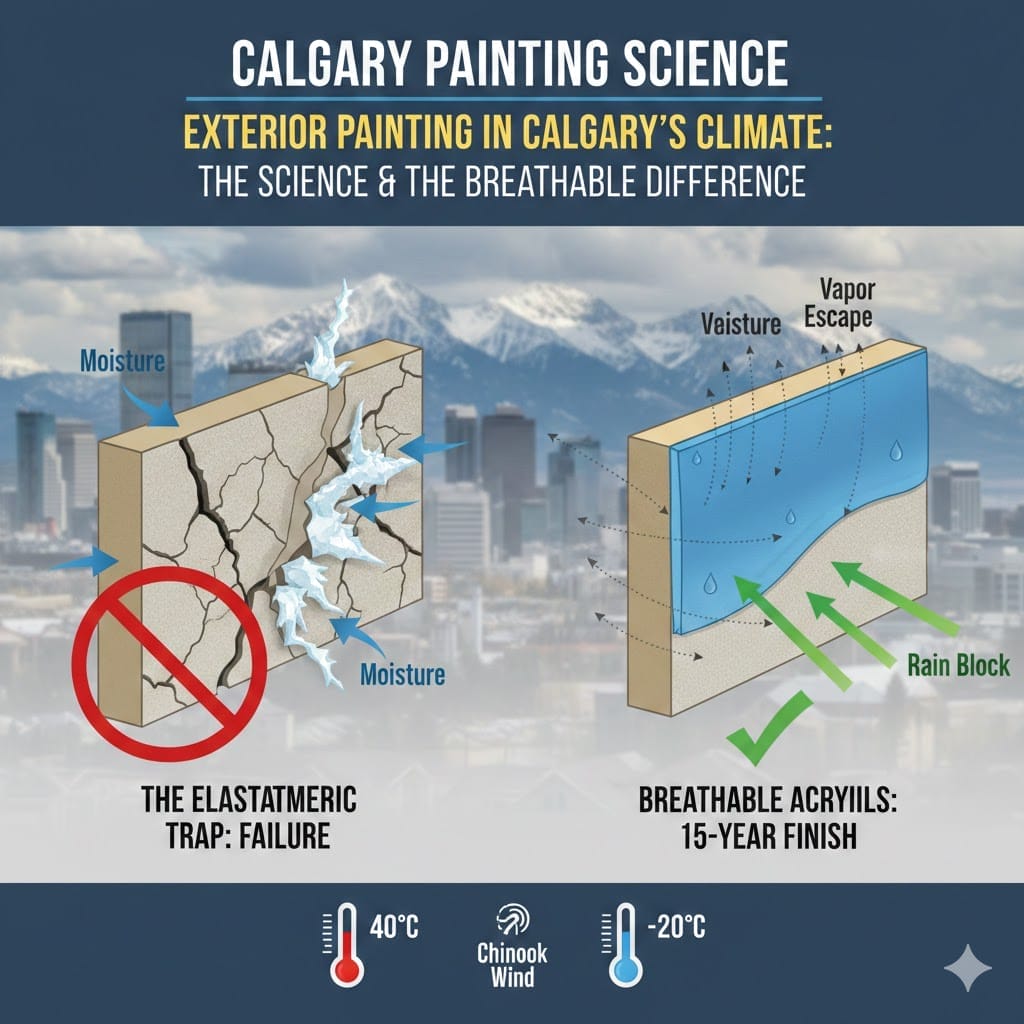
Why Exterior Painting in Calgary Is a Performance Decision, Not Just a Cosmetic One
In Calgary, an exterior paint job is not just about curb appeal. It is part of how your home handles UV exposure, moisture pressure, freeze-thaw stress, and the rapid weather swings that make Alberta hard on exterior finishes.
That is especially true for stucco homes. A coating can look great on day one and still be the wrong system for the wall if it traps moisture, ignores the grade line, or gets applied in the wrong weather window.
This guide explains the building-science side of Calgary exterior painting so homeowners can better understand why some jobs hold up and others fail early.
1. The Stucco Killer: Why Freeze-Thaw Cycles Are So Hard on Calgary Exteriors
Calgary’s climate is rough on exterior finishes because it combines snow, melt cycles, wind, sun, and sharp temperature swings. Chinook conditions are especially deceptive. Snow melts, moisture gets into vulnerable pores, cracks, and transition points, then temperatures swing back down fast enough to refreeze that moisture inside the wall surface.
When that happens repeatedly, the stress builds. Small weaknesses become larger ones. Hairline cracks widen. Weak coatings lose their bond. Areas that looked “fine for now” can shift into a repair issue much faster than homeowners expect.
Why Calgary is harder on stucco
- Rapid warm-to-cold reversals
- Snowmelt feeding porous areas
- Strong sun and UV exposure
- Seasonal movement around openings and joints
Best next step
If your home is already showing bubbling, cracking, or suspicious lower-wall damage, start with our Stucco Repair Calgary page before assuming it is only a paint problem.
2. The Breathability Factor: Why Stucco Needs the Right Coating System
One of the biggest exterior mistakes is choosing a coating based only on thickness or immediate coverage. On stucco, that can backfire badly if the system slows vapour movement too much and moisture gets trapped where it should have been able to escape.
Stucco needs to breathe. In Calgary, that matters even more because wall systems are dealing with snow, seasonal moisture, freeze-thaw pressure, and strong environmental exposure through the year.
That is why our approach stays aligned with breathable, premium exterior systems selected for long-term performance instead of shortcut logic. The goal is to repel bulk water while still respecting vapour movement where the assembly needs it.
Not sure whether the home needs stucco repair, repainting, or both?
That decision should be made on-site, not guessed from a colour chart. If the surface is already holding moisture, cracking, or failing near the base, the right scope may involve localized correction first and coating second.
3. Weather Windows Matter More Than Homeowners Think
Exterior paint is not just brushed on and done. It still needs the right conditions to bond and cure properly. One of the biggest Calgary mistakes is assuming a warm Chinook afternoon automatically means the wall is ready to paint.
Often, the air feels warm while the substrate is still cold, damp, or slow to respond. That disconnect can hurt adhesion, slow cure quality, and increase the risk of early chalking, weak film formation, or premature failure.
What professionals watch
- Actual surface temperature, not just air temperature
- Overnight lows after application
- Moisture still sitting in the wall
- Direct sun versus shaded exposure
Why Chinooks can fool people
The outside air may briefly feel paint-friendly, while the wall itself is still holding cold from the previous freeze cycle. That is one reason seasonal exterior timing needs judgment, not just optimism.
If you are comparing contractors, this is a useful separating line between a company that understands Alberta conditions and a company that is simply trying to get product on the wall quickly.
4. Extreme Prep: Why Foundation Trenching Helps Protect the Lowest Part of the Wall
The lower portion of an exterior wall is often where coating systems get punished first. Snow sits there. Soil moisture builds there. Splashback happens there. And when previous painters stop right at the dirt line, they leave the most vulnerable section of the wall exposed to repeat moisture problems.
That is why trenching back dirt or landscaping rock at the base can be such an important prep detail on the right homes. It gives access to the lower stucco line so the protective coating can be carried lower instead of stopping short exactly where moisture pressure is strongest.
For homeowners planning a full exterior scope, our Exterior Painting Calgary page explains how surface-specific prep and product selection affect long-term results.
5. Real Calgary Failure Pattern: Blistering and Breakdown at the Grade Line
One of the most common exterior failures we see is bubbling, softening, or visible coating breakdown near the foundation line. In many cases, the previous scope either painted too high above grade, ignored moisture movement, or used a coating approach that was not a great fit for the wall assembly.
What homeowners notice first
- Blistering near the bottom of the wall
- Surface softness or crumbling
- Recurring staining or discoloration
- Paint failure returning quickly after a repaint
What it usually points to
- Moisture wicking from below
- Inadequate lower-wall prep
- Coating incompatibility
- A repair issue being mistaken for a paint-only job
What This Means for Calgary Homeowners
The biggest exterior painting mistake is treating every wall like it needs the same generic scope. Calgary homes do not live in a gentle climate. The right exterior plan depends on exposure, material type, moisture sensitivity, grade conditions, repair history, and whether the wall can actually support a coating-first approach.
That is why proper exterior painting in Calgary is less about “freshening up the colour” and more about choosing the right prep and product path for the wall in front of you.
If you want to compare real finished work before booking, visit our project gallery. For broader reading paths, you can also use our house painting Calgary guide hub.
Exterior Painting FAQs for Calgary Homes
Why does stucco often fail near foundations?
Usually because the lower wall deals with moisture from snow, splashback, and soil contact. If the grade line is ignored or moisture keeps wicking upward, that area often becomes the first place the coating or stucco starts to fail.
Can exterior painting be done during a Chinook?
Sometimes, but the wall itself still needs to be evaluated. A warm afternoon does not always mean the substrate is dry, stable, and ready for proper coating performance.
Why must stucco breathe?
Because moisture can still move into or behind the surface over time. If the coating system restricts vapour movement too much for that assembly, the wall can stay wetter than it should and become more vulnerable to damage.
Does thicker always mean better on exterior coatings?
No. On stucco especially, compatibility and vapour behaviour matter just as much as build. A thick coating can still be the wrong coating.
How do I know whether my home needs repair or just repainting?
If there is cracking, bubbling, softness, lower-wall breakdown, or suspicious moisture patterns, the safest next step is an on-site assessment. Many Calgary homes need a repair-first decision before finishing starts.
Protect Your Home for the Long Term
In Calgary, exterior painting should be approached like a performance system, not a cosmetic afterthought. The coating only works as well as the prep, timing, and wall conditions underneath it.
Dynamic Painting helps homeowners build smarter exterior scopes around real Alberta exposure, stronger preparation, better product selection, and a clearer understanding of whether the wall needs paint, repair, or both.